What Is the Japanese Trick for Sleep Apnea (And Does It Actually Work)?
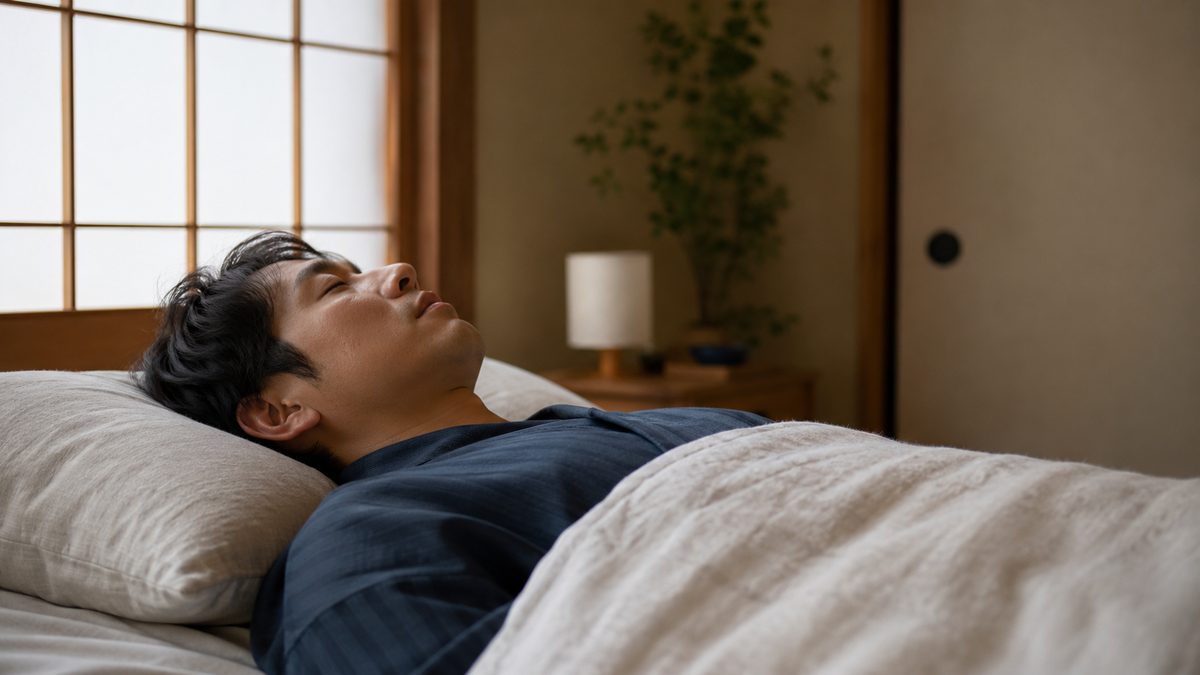
The "Japanese trick" for sleep apnea is orofacial myofunctional therapy (OMT): a structured program of tongue, throat, and soft palate exercises that strengthen the muscles most likely to collapse your airway at night. Clinical trials show it can reduce apnea severity by 30 to 50% in people with mild-to-moderate obstructive sleep apnea (OSA).
You need about 10 to 20 minutes of daily practice for three to six months to see real results. It won't replace CPAP for moderate-to-severe disease, but for the right person it's a legitimate, evidence-backed tool.
Why does your airway collapse during sleep?
Obstructive sleep apnea happens when the muscles around your throat relax too much as you drift off. Your tongue falls back, your soft palate droops, and the airway narrows or closes completely.
Your brain detects the drop in oxygen, sends a wake-up signal, and the cycle repeats dozens or hundreds of times per night without you ever knowing.
The muscles involved are trainable, the same way a weak lower back gets stronger with targeted rehab. That's the entire premise of myofunctional therapy. Strengthen the tongue, the soft palate, and the lateral pharyngeal walls enough and they hold their position even when you're fully relaxed. The airway stays open.
What most articles miss: this isn't a relaxation technique or a breathing hack. It's resistance training for the inside of your throat. The adaptations are structural, and they take time, just like any other muscle-building program.
What do the Japanese use to reduce sleep apnea?
Japanese sleep medicine has a long tradition of using non-device approaches alongside conventional treatment. The exercises associated with the "Japanese trick" target the same muscle groups studied in Western myofunctional research: tongue posture and range of motion, swallowing pattern retraining, lip seal, and soft palate elevation.
A common routine includes pressing the tongue flat against the roof of the mouth and holding it there, pulling the tongue back forcefully toward the throat, sucking the tongue upward like a suction cup, chewing exercises to engage the lateral jaw muscles, and repetitive swallowing with correct tongue placement.
The point isn't any single exotic move. It's the consistent, progressive loading of muscles that have gone chronically under-used.
In my experience reviewing this area, the "Japanese trick" label is mostly a marketing frame. The underlying therapy is the same orofacial myofunctional work that speech pathologists and sleep physiologists have been testing in peer-reviewed trials for over a decade.
What does the research actually show?
The evidence base has grown substantially since the early 2010s. A 2019 Cochrane review examined oropharyngeal exercises for obstructive sleep apnoea and found consistent reductions in apnea-hypopnea index (AHI) scores across trials. Cochrane reviews apply strict methodology, so inclusion in one carries weight.
A 2023 experimental study on obese patients with mild-to-moderate OSA put participants through a five-day-per-week exercise program for six weeks. After just six weeks, researchers recorded significant drops in neck circumference, Epworth Sleepiness Scale scores, and snoring frequency.
Six weeks is a short window. It suggests early adaptations happen faster than most people expect.
A 2025 Spanish trial with 32 participants ran for 20 weeks and combined OMT with cervical spine exercises. Results showed improvements in AHI, overnight oxygen levels, daytime sleepiness, and quality of life measures.
The addition of neck exercises is worth noting because forward head posture mechanically narrows the pharyngeal space. Fixing posture while training the throat muscles addresses two contributors at once.
A 2026 Egyptian study with 35 adults found that a three-month OMT program combined with breathing work improved sleep study markers. The combination approach is a recurring theme in the stronger trials.
OMT paired with something else (weight loss, positional therapy, breathing retraining, neck exercise) consistently outperforms OMT alone.
Earlier systematic reviews reached similar conclusions: the evidence supports OMT as a meaningful adjunct for mild-to-moderate OSA. Most trials excluded severe cases and used varying protocols, making direct comparison difficult.
What is the pillow trick for sleep apnea?
The pillow trick is positional therapy, not exercise. It works on a simple principle: airway collapse is significantly worse when you sleep on your back. Gravity pulls the tongue and soft palate straight down onto the posterior pharyngeal wall.
Roll onto your side and that gravitational load disappears.
The classic pillow trick involves placing a firm pillow (or a tennis ball sewn into the back of a shirt) behind you so that rolling onto your back wakes you or becomes uncomfortable enough that you roll back. More sophisticated versions use positional alarm devices that vibrate when they detect supine sleep.
For positional OSA, where AHI is at least twice as high on your back as on your side, positional therapy can cut apnea events dramatically on its own. Combining positional changes with OMT gives you two independent mechanisms working simultaneously, which is why the better clinical programs use both.
Who does OMT work for, and who should skip it?
OMT has the strongest evidence for adults with mild-to-moderate OSA, meaning an AHI between 5 and 30 events per hour, without severe obesity or significant craniofacial abnormalities. If your anatomy is the primary driver (small jaw, large tonsils, significant nasal obstruction), muscle training alone won't overcome a structural problem.
If your BMI is above 35, excess soft tissue around the throat adds a mechanical load that exercises can't fully offset. Weight loss in that range typically produces larger AHI reductions than any exercise program. The exercises can still help, but they shouldn't be the primary strategy.
For moderate-to-severe OSA (AHI above 30), CPAP remains the standard of care because the risk of untreated disease is too high. Cardiovascular damage, metabolic disruption, cognitive impairment. These are serious consequences.
Using OMT while tolerating CPAP poorly is a reasonable conversation to have with your sleep physician. Using OMT instead of CPAP for severe disease is not.
Children with OSA and mouth-breathing habits are actually among the best responders to myofunctional therapy, often showing larger AHI reductions than adults. If you're reading this for a child, a paediatric speech pathologist with myofunctional training is the right first call.
What is the best natural remedy for sleep apnea?
The honest answer is that "natural remedy" covers a wide range of quality. The interventions with the strongest evidence behind them are orofacial myofunctional therapy, positional therapy for positional OSA, and weight loss for overweight or obese patients.
Those three aren't alternative medicine. They're standard recommendations in sleep medicine guidelines.
Nasal breathing support, whether through nasal strips, saline rinses, or treating underlying allergies, reduces the upstream resistance that makes airway collapse more likely. It's not a standalone fix, but it's a legitimate adjunct.
Alcohol is a direct muscle relaxant that worsens OSA consistently. Cutting evening alcohol is one of the fastest acting changes most people can make. The effect is measurable the same night.
Sleep position, as covered above, can have a large effect for positional OSA. It costs nothing and has no side effects.
What the evidence does not support as meaningful standalone treatments: anti-snoring mouthguards bought over the counter without a dentist fitting (custom mandibular advancement devices are different), herbal supplements, essential oils, or didgeridoo playing (which has a single small trial behind it and no replication).
How do you actually do the exercises?
A standard OMT session runs 10 to 20 minutes. Most programs are structured around four to six core exercises performed in sequence, repeated daily or five days per week. A typical starting set looks like this:
Press your tongue firmly against the roof of your mouth and hold for three seconds. Repeat 20 times. This trains resting tongue posture, the position your tongue should maintain automatically during sleep.
Place the tip of your tongue behind your front teeth, then slide it backward along the roof of your mouth as far as it goes. This is called the tongue slide. Repeat 20 times.
Suck your tongue upward so the entire surface presses flat against the palate. Hold for three seconds. This is the most demanding exercise for most people early on because it requires significant tongue-to-palate contact force.
Open and close your mouth while keeping your tongue on the palate. This is the palate stretch, and it's uncomfortable at first because it fights the habitual resting position most adults have developed from years of mouth breathing.
Finish with 20 repetitions of a forceful swallow with your lips closed and teeth lightly together, focusing on the back of the tongue driving upward and backward.
Progression matters. Like any strength training, you add repetitions and resistance over weeks. A speech pathologist or physiotherapist trained in myofunctional therapy will progress you systematically.
Self-directed YouTube programs can get you started, but they tend to plateau because there's no one assessing your form or advancing the difficulty.
What most articles get wrong about this topic
The first thing they get wrong is framing OMT as a cure. It's not. It's a reduction tool. A 40% drop in AHI is genuinely meaningful for someone with mild OSA. It can move them out of the clinical threshold entirely.
For someone with severe OSA, a 40% drop still leaves them with significant disease.
The second thing they get wrong is timeline. Most articles say "results in weeks." The six-week data from the 2023 study shows early improvements in sleepiness and snoring, but structural AHI changes take longer. Three to six months is the realistic window for sleep study improvement.
Expecting dramatic results in two weeks sets people up to quit.
The third thing almost no article mentions: compliance is the real variable. The people who see results are the ones who treat this like brushing their teeth, a daily non-negotiable, not a thing they do when they remember. The exercises themselves aren't hard. Doing them every day for six months is the actual challenge.
Frequently asked questions
Can OMT cure sleep apnea permanently? For some people with mild OSA, consistent training can bring AHI below the clinical threshold and keep it there, especially if combined with weight maintenance and good sleep positioning. Most clinicians frame it as management rather than cure because detraining (stopping the exercises for months) can allow symptoms to return.
How long before I see results? Sleepiness scores and snoring improvements often appear within six to eight weeks. Meaningful AHI reductions on a sleep study typically take three to six months of consistent practice.
Do I need a professional or can I do this myself? You can start with self-directed exercises, and many people do. A speech pathologist or physiotherapist with myofunctional training will get you better results because they can assess your specific weaknesses, correct technique errors you can't see yourself, and progress the difficulty appropriately.
Can I do OMT while using CPAP? Yes. Some people use OMT specifically to reduce their CPAP pressure requirements over time, or to improve outcomes when CPAP tolerance is poor. This should be done with your sleep physician's knowledge so they can retest and adjust settings.
Is OMT safe? The exercises carry essentially no risk for healthy adults. If you have recent oral surgery, temporomandibular joint (TMJ) issues, or neurological conditions affecting the muscles involved, check with your treating clinician first.
What if I have severe sleep apnea? Get standard treatment first. CPAP, oral appliances fitted by a dentist, or surgery depending on your anatomy and severity. OMT can be discussed as an adjunct once your disease is under control, but it shouldn't delay effective treatment for severe OSA.
Your next step
If you suspect you have sleep apnea, the first move is a sleep study. You can't manage a condition you haven't measured. Once you have an AHI number and a severity classification, you know whether OMT is a primary option, a useful add-on, or something to return to after addressing bigger factors first.
If you already have a diagnosis in the mild-to-moderate range and want a non-device option to explore, start the tongue exercises daily for six weeks and get a repeat sleep study at the three-month mark. That feedback loop tells you whether your throat is responding.
If it is, keep going. If AHI is unchanged, you have useful information and you haven't wasted a year finding out.
The physiotherapists at PTNA work with patients on the musculoskeletal and neuromuscular components of sleep-disordered breathing. If you want a structured program rather than working from a YouTube video, that's where to start the conversation.Sources
Explore related health and wellbeing guides
This article is part of PTNA's consumer health and wellbeing library. Browse the Health & Wellbeing Resources hub to find related guides by topic, including Australian health cover, Medicare, prostate health, mental health, disability support and life insurance.
How Much Does It Cost to Have Your Prostate Removed Privately in Melbourne?
Read article →
Is It Worth Having Your Prostate Removed in Melbourne?
Read article →
Can You Get Anything Free if You Have Cancer in Melbourne?
Read article →
What Are the Negatives of Removing Your Prostate in Melbourne?
Read article →
Is Prostate Cancer Classed as a Disability in Melbourne?
Read article →