What Is Life Like for a Man Without a Prostate? What Nobody Tells You

Yes, a man can survive without his prostate. Most men who have a prostatectomy go on to live full, long lives. But the transition is harder than most surgeons have time to explain in a pre-op appointment, and the challenges are more specific than "there may be some side effects."
This article is for men who want to know what they are actually walking into, and for the partners and family members trying to understand what their loved one is going through. PTNA
What Does the Prostate Actually Do?
The prostate is a walnut-sized gland that sits just below the bladder and wraps around the urethra. It has two main jobs. It produces fluid that makes up most of the volume of semen, and it helps control urinary flow through its position around the urethra.
When the prostate is removed, both of those functions are gone. The body does not replace them. That is the starting point for understanding what changes and what does not.
What Are the Consequences of Living Without a Prostate?
The consequences split into two categories: the ones that affect almost everyone, and the ones that affect some men depending on age, nerve preservation, and how the surgery went.
Nearly every man who has a prostatectomy experiences some degree of urinary incontinence and some change in sexual function. The degree varies widely, and both tend to improve over time, but they rarely vanish completely without active rehabilitation.
Urinary Incontinence
The prostate plays a structural role in urinary control. After it is removed, the urethral sphincters have to compensate and carry more of the workload on their own. For most men, especially in the first weeks and months, they are not ready for that.
Stress incontinence is the most common type after prostatectomy. That means leaking when you cough, sneeze, lift something, or stand up quickly. One of my clients described it as feeling like his body had completely betrayed him. He was a 58-year-old builder who had never thought twice about physical activity. Three weeks post-surgery, he was wearing pads to work and planning every trip around bathroom access.
The good news is that for many men, continence improves significantly within six to twelve months. Pelvic floor rehabilitation, started before surgery if possible and continued consistently after, makes a real measurable difference. The men I have worked with who committed to pelvic floor exercises before their surgery date generally had faster and more complete recovery. That is not anecdote, it is well-supported in the urology literature.
A smaller number of men experience persistent incontinence beyond twelve months. For them, options exist, including urethral slings and artificial urinary sphincter devices. These are not last resorts. They are legitimate interventions with strong outcomes when incontinence is not resolving on its own.
Erectile Dysfunction
The nerves that control erections run along the outside of the prostate. Even with nerve-sparing surgery, those nerves are handled, stretched, and sometimes cut. The result is that erectile dysfunction after prostatectomy is extremely common, particularly in the first year.
This is one area where most men are underprepared. They hear "nerve-sparing" and assume erectile function will return to normal relatively quickly. For some men it does. For many, recovery takes eighteen months to two years. For others, it does not return to pre-surgery levels without medical support.
Penile rehabilitation, which involves using medication or vacuum erection devices to maintain blood flow to the erectile tissue during the nerve recovery phase, is something most men are not told enough about. When I have worked with clients whose urologists gave them a clear rehabilitation plan from week four onwards, their outcomes were noticeably better than those who were simply told to wait and see.
Orgasm is still possible without a prostate. The sensation changes for some men, and dry orgasm replaces ejaculation because there is no longer prostatic fluid or seminal vesicle fluid being expelled, but the experience of orgasm remains. This surprises many men who assumed that removing the prostate meant the end of sexual pleasure entirely.
Dry Ejaculation and Fertility
After prostatectomy, a man will no longer ejaculate semen. The prostate and seminal vesicles are both removed as part of a radical prostatectomy, which means there is no fluid to expel. Orgasm still produces muscular contractions, but nothing comes out.
This also means natural fertility is gone after surgery. If having biological children is a consideration, sperm banking before the procedure is worth discussing with a urologist before the operation date, not after.
What Is Life Expectancy After Prostate Removal?
For men who have a prostatectomy to treat localised prostate cancer, the survival outcomes are strong. The ten-year survival rate for localised prostate cancer treated with radical prostatectomy is above 95 percent in most studies. Many men live another twenty or thirty years after surgery.
The prostate is not an organ the body needs to sustain life. You do not need it to breathe, pump blood, filter waste, or do any of the things that keep you alive. What changes is quality of life, not quantity, at least in terms of the surgery itself.
What actually affects long-term health after prostatectomy is how well the cancer was controlled, whether the man commits to rehabilitation, and whether the functional changes like incontinence and erectile dysfunction are actively managed. Men who disengage from recovery, who stop pelvic floor work, avoid intimacy, and withdraw socially tend to report worse overall wellbeing than men who stay engaged with their recovery and with their health professionals.
The Part Most Articles Miss: The Psychological Weight
The physical changes are real and they are well-documented. But there is a layer underneath them that does not get enough attention.
Many men experience a grief response after prostatectomy that they were not expecting and do not have language for. It is not depression in the clinical sense, though that happens too. It is more like a quiet disorientation. The body that a man has known for fifty or sixty years now works differently, and some of what made him feel like himself, his sexual confidence, his physical ease, his sense of bodily control, has changed in ways he did not fully anticipate.
I remember one client telling me, months into his recovery, that he wished someone had just sat him down before surgery and said: "This is going to be a process, not an event. You are not going to wake up from surgery and then go back to normal. You are going to build a new normal, and it takes time, and that is okay." He said nobody had told him that, and the gap between what he expected and what he experienced made the first six months much harder than they needed to be.
Partners carry this too. The shift in sexual function and the emotional adjustment affect both people in a relationship. Couples who talk openly about what is happening tend to navigate it far better than those who do not. That is not a platitude. It is what consistently comes up when men reflect on what actually helped.
What Genuinely Helps During Recovery
Pelvic floor physiotherapy is the most evidence-based intervention for post-prostatectomy incontinence, and it is still underutilised. Starting it before surgery gives men a head start. Continuing it consistently after surgery makes a difference that medications and waiting alone do not replicate.
Penile rehabilitation, discussed above, is worth asking your urologist about directly if they do not raise it first. The window for it matters. Starting early in the recovery period is better than waiting to see how things go.
Staying physically active, within the limits your surgeon sets, supports continence recovery, cardiovascular health, and mood. It also gives men something constructive to focus on during a period that can otherwise feel passive and uncertain.
Finding a support group or connecting with other men who have been through prostatectomy can cut through the isolation that many men feel. The experience is more common than most men realise, and hearing from someone eighteen months ahead of you that continence improved and life got good again is worth more than any pamphlet.
The Angle Most Articles Get Wrong
Most articles about life after prostatectomy frame it as either uniformly difficult or uniformly manageable. Neither is accurate.
What is actually true is that outcomes are far more variable than patients are led to believe, and that variability is partly within a man's control. The men who do the prehabilitation work, who engage with penile rehabilitation, who stay in contact with their care team, and who involve their partners in the recovery process do better. Not because they got lucky, but because recovery from prostatectomy is active, not passive.
The second thing most articles miss is that dry orgasm is not the end of a sex life. It is different, and it takes adjustment, but men who are given accurate information about it beforehand adjust faster than those who experience it as a surprise. What feels like a loss when it is unexpected often becomes a non-issue once it is understood and anticipated.
The third thing is that the urinary and erectile changes have a wider emotional impact than most pre-operative conversations acknowledge. Setting realistic expectations about the timeline, including that meaningful improvement often continues for up to two years, changes how men experience the recovery. The men who know it is a long process cope better than those who expected to be "back to normal" within weeks.
Frequently Asked Questions
Can a man survive without his prostate?
Yes, completely. The prostate is not essential for life. Men live for decades after prostatectomy. The surgery removes an organ that contributes to semen production and plays a structural role near the urethra, but neither of those functions is necessary for survival.
Will I always be incontinent after prostate removal?
Most men are not permanently incontinent. The majority regain useful continence within six to twelve months, particularly with pelvic floor physiotherapy. A smaller group has persistent incontinence beyond twelve months, and for them, surgical options exist with good outcomes.
What happens to erections after a prostatectomy?
Erectile dysfunction is common after prostatectomy, especially in the first year. With nerve-sparing surgery and active penile rehabilitation, many men recover erectile function over eighteen to twenty-four months. Some men need ongoing support from medication or devices. age and pre-surgery erectile functione function both affect outcomes.
Can a man still have an orgasm without a prostate?
Yes. Orgasm is still possible after prostatectomy. It will be a dry orgasm because there is no longer semen to ejaculate, but the sensation and muscular response of orgasm remain. Most men find this less disruptive than they expected once they know about it in advance.
How long does recovery from prostatectomy take?
The surgical recovery is typically four to six weeks before returning to normal activity. But the functional recovery, meaning continence and erectile function, continues for up to two years. The first three months are usually the most difficult. Most men see meaningful improvement by twelve months.
Is life after prostate removal normal?
Different, yes. Abnormal, no. Most men return to work, exercise, relationships, and sex after prostatectomy. The adjustment period is real and takes longer than most people expect. But the majority of men who have been through it describe their quality of life as good once the recovery period has passed.
What to Do Now
If you are preparing for surgery, start pelvic floor exercises now, before your operation date. Ask your urologist directly about penile rehabilitation and when to start. And find a physiotherapist who specialises in men's pelvic health, not a general physio who has seen it a few times, but someone for whom this is their focus.
If you are already post-surgery and struggling, the most useful thing you can do is get a referral to a men's pelvic health physiotherapist. The timeline for improvement is longer than most men are told, and professional guidance makes that timeline shorter.
Prostate cancer and prostatectomy physio support is available through clinics like PTNA, where pelvic floor rehabilitation for men is a core part of what they do, not an add-on.
Explore related health and wellbeing guides
This article is part of PTNA's consumer health and wellbeing library. Browse the Health & Wellbeing Resources hub to find related guides by topic, including Australian health cover, Medicare, prostate health, mental health, disability support and life insurance.
How Much Does It Cost to Have Your Prostate Removed Privately in Melbourne?
Read article →
Is It Worth Having Your Prostate Removed in Melbourne?
Read article →
Can You Get Anything Free if You Have Cancer in Melbourne?
Read article →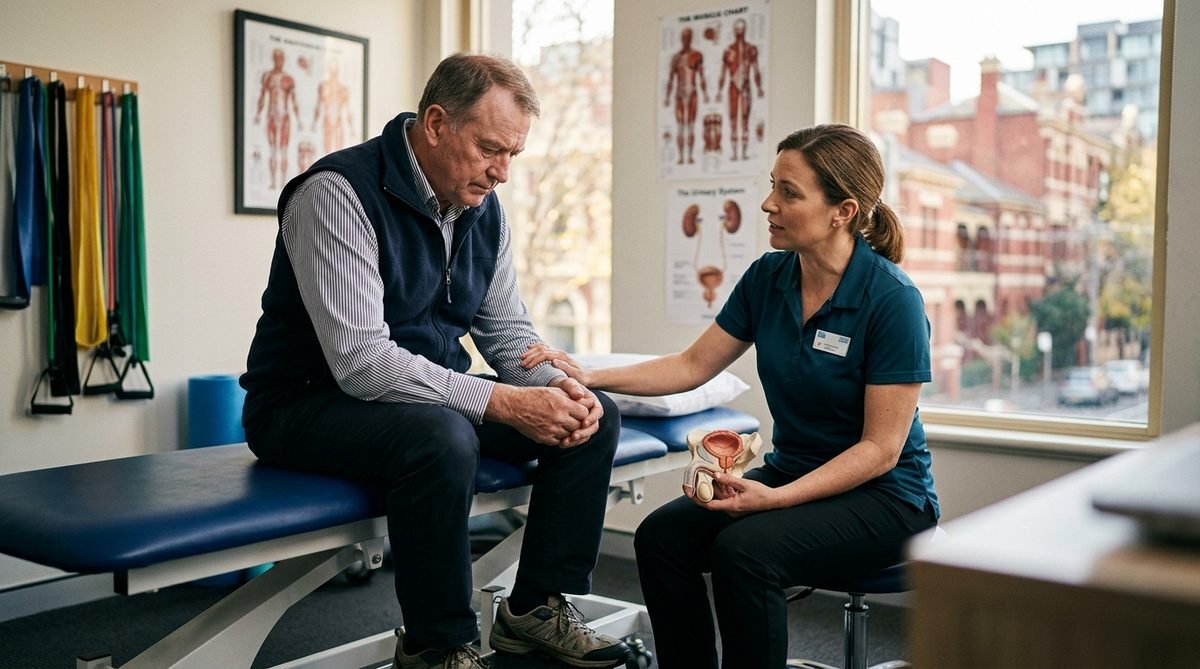
What Are the Negatives of Removing Your Prostate in Melbourne?
Read article →
Is Prostate Cancer Classed as a Disability in Melbourne?
Read article →