Is a Tooth Implant Covered by Bupa? What Australian Patients Actually Get
The short version: Bupa does offer some cover for dental implants, but most patients are surprised by how little it pays out. The gap between what Bupa pays and what the procedure actually costs can still run into thousands of dollars.
If you're planning on implants and assuming your health fund will take care of most of it, this article will save you from a very unpleasant surprise at the front desk.
Does Private Health Insurance Cover Dental Implants in Australia?
Yes, but only under specific extras cover policies, and only up to annual limits that rarely reflect real-world implant costs. In Australia, dental implants fall under "major dental" in most private health fund policies.
You need a policy that includes major dental cover, and you need to have served the waiting period, which is typically 12 months.
Even then, what the fund pays is capped. Most funds, including Bupa, set annual limits on major dental anywhere from $1,000 to $3,000 per person depending on your policy tier. A single implant in Australia typically costs between $3,000 and $6,500 all up.
So the math rarely works in the patient's favour.
What I see consistently with clients who come in expecting their health fund to cover the bulk of treatment is disappointment. Not because the cover doesn't exist, but because the gap between expectation and reality is large.
One of my clients came in with a Bupa Gold policy, certain she'd be fine. Her annual major dental limit was $1,500. Her implant quote was $4,800. Bupa paid a portion of that $1,500 cap, and she paid the rest out of pocket.
Are Implants Covered by Bupa Specifically?
Bupa does cover implants under their extras policies that include major dental. The key word is "some."
Bupa uses a benefits schedule, and implants are covered at a percentage of that schedule, not a percentage of what your dentist charges. That distinction matters because most dentists charge above the Bupa schedule.
Bupa's top-tier extras policies offer the highest annual limits and may include implant cover, but you need to read the product disclosure statement carefully. The item numbers relevant to implants are 684 (implant fixture), 686 (implant crown), and a few others depending on the procedure.
Your dentist's quote should include item numbers. Match those to what your Bupa policy covers before you commit.
Bupa also has its own dental centres. If you use a Bupa-owned clinic, you may get a no-gap or reduced-gap offer on some treatments, but implants are typically excluded from those no-gap arrangements because of the cost involved. Worth calling to confirm before you book.
Here's what most articles miss: the annual limit resets each calendar year. If you're strategic about timing, you can split a two-stage implant procedure across two calendar years and claim the annual benefit twice.
Stage one, which is the implant fixture placement, in November or December. Stage two, the crown, in January or February. I've had clients save an extra $1,000 to $1,500 doing exactly this. It requires planning with your dentist, but it's completely legitimate.
How Much Does a Single Tooth Implant Cost in Australia?
A single tooth implant in Australia typically costs between $3,000 and $6,500. The range is wide because the total cost depends on whether you need a bone graft, a sinus lift, or other preparatory work before the implant can be placed.
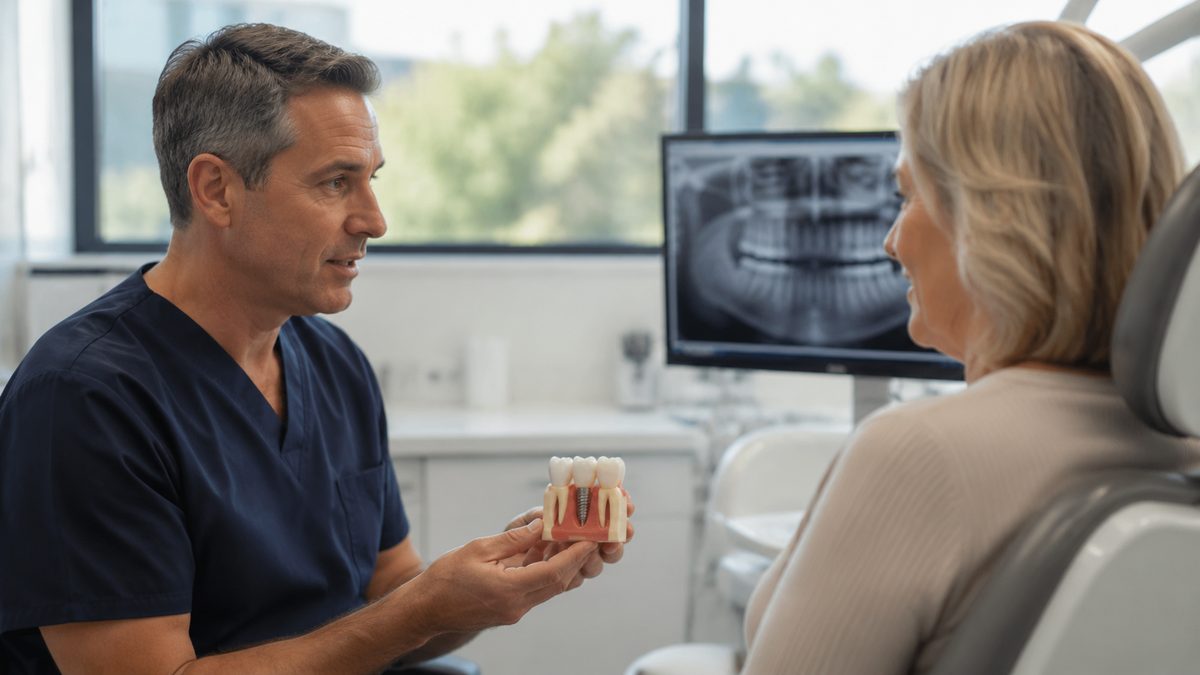
Breaking it down, the implant fixture itself sits around $1,500 to $2,500. The abutment, which connects the implant to the crown, adds another $500 to $800. The crown on top runs $1,500 to $2,500 depending on the material and where the tooth is located.
Any bone grafting or preparatory surgery adds cost on top of all that.
Location matters too. Capital city dental practices in Sydney and Melbourne tend to charge more than regional practices. A quote of $4,200 in Brisbane might be $5,400 for the same procedure in inner Sydney.
The thing most people don't factor in is the consultation and imaging costs. A cone beam CT scan, which most implant dentists require, runs $200 to $400. Initial consultations add another $80 to $200.
These aren't always included in the headline quote.
When I had this conversation with a client recently who was comparing two quotes, $3,800 and $5,200, the cheaper one didn't include the CT scan, the abutment, or a temporary crown. Once we added those in, both quotes came out within $300 of each other.
Always ask for an itemised quote with every item number listed.
What Does Bupa Actually Pay Out on an Implant?
This is where it gets specific. Bupa pays a benefit based on their own schedule of fees for each item number. The gap you pay is the difference between what your dentist charges and what Bupa pays.
For a rough example, if Bupa's schedule fee for item 684 (implant fixture) is $1,200 and your dentist charges $2,000, Bupa might pay 60% to 80% of their schedule fee, which is $720 to $960. You pay the rest, which is $1,040 to $1,280 on that item alone, plus your dentist's gap above the schedule.
The actual benefit percentage depends on your specific policy. check your policy document or call Bupa directly with the item numbers from your dentist's quote. They can give you an exact estimate before you proceed.
Your annual limit also caps the total you can claim in a year. Once you hit that cap, Bupa pays nothing more until the new year.
If your implant procedure crosses the annual limit, you carry the rest.
How to Get Free Dental Implants in Australia
There is no reliable pathway to getting implants completely free in Australia, but there are ways to significantly reduce the cost.
Dental schools offer implant treatment at reduced rates, sometimes 30% to 50% below private practice prices. The University of Melbourne, University of Sydney, Griffith University, and others have dental clinics where supervised students and postgraduate dentists perform implant procedures.
Waiting lists are long, often six to twelve months, but the savings are real. One of my clients waited eight months through a dental school program and paid $2,100 for a procedure quoted at $4,800 privately. The work was done by a supervised postgraduate student who had already placed dozens of implants.
The public dental system in Australia does not routinely provide implants. Dentures and extractions are covered under public dental for eligible patients, but implants are generally considered elective and are excluded. Some states have exceptions for specific clinical cases, but this is rare and not something to count on.
Some practices offer payment plans, and third-party finance providers like DentiCare or Afterpay Health let you spread the cost over twelve to twenty-four months. This isn't free, but it makes the cost manageable without taking on high-interest debt if you use a no-interest plan.
Veterans may access implant treatment through DVA (Department of Veterans' Affairs) if there's a clinical need. If you're eligible for DVA dental, it's worth speaking to your treating dentist about what's covered under your entitlements.
The Part Most People Get Wrong About Health Fund Timing
A lot of people sign up for extras cover the month they need an implant and are confused when their claim is declined or heavily restricted. Major dental has a 12-month waiting period on almost every policy in Australia. There is no way around this.
If you've just joined Bupa and want an implant next month, you're paying out of pocket.
If you're already with Bupa and thinking about upgrading your extras to include better major dental cover, the upgrade waiting period applies to the new benefits. So if you upgrade from a basic to a premium extras policy, you may still wait 12 months before claiming at the higher limit.
The time to think about your health cover is before you need it, not after the tooth becomes a problem. I know that's easy to say in hindsight.
But if you currently have a tooth that's borderline, that you know will probably need major work in the next year or two, now is the time to review your cover and upgrade if needed.
Is It Worth Upgrading Your Bupa Policy for Implants?
Run the numbers before you upgrade. The difference in premium between a basic and a top-tier extras policy can be $600 to $1,200 per year. If upgrading gets you an extra $1,000 in major dental benefit, and you're going to wait 12 months anyway, you might spend more on the premium upgrade than you gain in benefit.
Where upgrading makes sense is when you have ongoing dental needs across multiple years, not just a single implant. If you're likely to need implants and crowns and other major work over the next few years, a higher-tier policy with better annual limits can pay off.
If you need one implant and nothing else, the math is often marginal.
Compare what you'd pay in extra premiums over 12 months against the increase in your annual major dental benefit. That's the calculation. Bupa's website lets you compare policies side by side, and you can call them to ask exactly what each policy pays on specific item numbers. Learning how Bupa calculates benefits across different procedures helps you make informed decisions. understanding how Bupa covers specific procedures
FAQ
Does Bupa cover the full cost of a dental implant?
No. Bupa contributes a portion based on their schedule fees and your annual limit. Most patients pay a significant gap even with top-tier cover.
Expect to pay at least $2,000 to $4,000 out of pocket on a standard implant even with good extras cover.
What Bupa policy covers dental implants?
You need a Bupa extras policy that includes major dental. Higher-tier policies like Top Extras or equivalent offer higher annual limits and better benefits on implant item numbers.
Basic and mid-range extras policies may have low annual limits that barely touch implant costs.
Can I claim dental implants on Medicare?
No. Medicare does not cover dental in Australia for general adult patients. There is the Child Dental Benefits Schedule for children under 18, but implants aren't covered under that either.
The CDBS covers basic preventive and restorative work only.
How long does a dental implant last?
With proper care, implants can last 20 to 30 years or longer. The crown on top may need replacing after 10 to 15 years. The implant fixture itself is designed to be permanent.
This longevity is one reason implants compare favourably to bridges and dentures over a full lifetime cost analysis.
What if I can't afford an implant right now?
A dental school program is the most cost-effective option for most people. Payment plans through the dental practice or third-party finance are another option.
Some dentists also offer staged treatment where you pay for each stage as it's completed rather than the full cost upfront.
Does Bupa cover bone grafts needed before an implant?
Bone grafting has its own item numbers and may be covered under major dental, subject to your annual limit. Whether it's covered depends on your specific policy.
Ask your dentist to include bone graft item numbers in the quote and check those with Bupa directly.
What to Do Before You Book Your Implant
Get an itemised quote from your dentist with every item number listed. Call Bupa with those item numbers and ask exactly what your policy pays on each one.
Check your remaining annual limit for the current year. If your procedure has two stages, ask your dentist whether splitting across two calendar years is feasible.
Then compare the real out-of-pocket cost against dental school pricing if cost is a significant factor for you.
The one action worth taking today: call Bupa on 134 135, give them the item numbers from your quote, and ask for a written benefit estimate. It takes ten minutes and removes all the guesswork.
Explore related health and wellbeing guides
This article is part of PTNA's consumer health and wellbeing library. Browse the Health & Wellbeing Resources hub to find related guides by topic, including Australian health cover, Medicare, prostate health, mental health, disability support and life insurance.
How Much Does It Cost to Have Your Prostate Removed Privately in Melbourne?
Read article →
Is It Worth Having Your Prostate Removed in Melbourne?
Read article →
Can You Get Anything Free if You Have Cancer in Melbourne?
Read article →
What Are the Negatives of Removing Your Prostate in Melbourne?
Read article →
Is Prostate Cancer Classed as a Disability in Melbourne?
Read article →