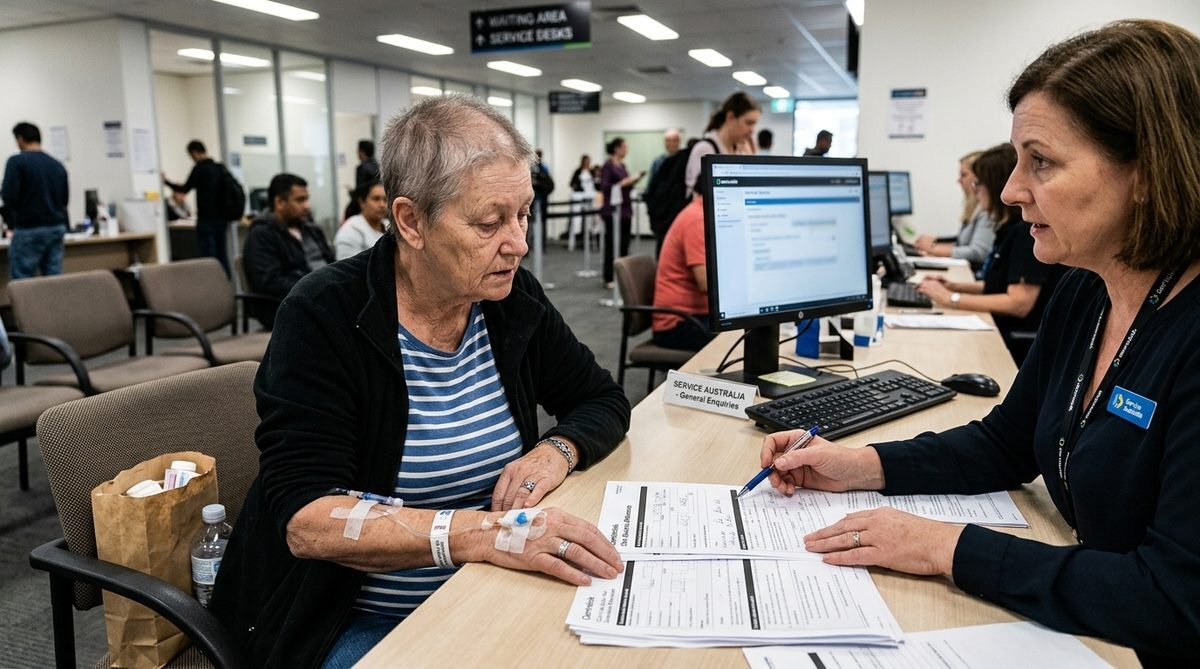
Does psoriasis qualify you for disability?

Yes, psoriasis can qualify you for disability, but the diagnosis alone is rarely enough. The key test is how much it limits your daily life and ability to work. Severe skin damage, constant pain, poor hand or foot function, treatment side effects, and psoriatic arthritis may support a claim.
Mild psoriasis that responds well to treatment usually won't.
The main idea is simple: disability systems look at what you can do, not just the name of your disease. Two people may have the same diagnosis but get different decisions because their symptoms affect them in different ways. One may keep working with small changes.
The other may be unable to stand, grip tools, sleep, travel, or attend work on a steady basis.
How severe must the condition be in Australia?
Australia uses different definitions for income support, workplace rights, insurance, and access to services. No single certificate makes someone disabled for every purpose. claim money for psoriasis
For the Disability Support Pension, the condition generally needs to be diagnosed, reasonably treated, stabilised, and expected to cause lasting impairment. The person must also meet medical and work-capacity rules. A psoriasis diagnosis from a GP helps, but a detailed report from a dermatologist or rheumatologist usually gives the decision maker clearer proof.
The work test goes beyond whether you can do one task on a good day. It asks whether you can keep doing suitable work within the required limits over time. How often you flare matters here.
Someone who completes one short shift but then needs two days to recover may have far less work capacity than a clinic test suggests.
The impairment tables used for Australian disability decisions focus on loss of function. Psoriasis may be assessed through the body functions it affects, including skin function, use of the limbs, stamina, or mental function when a diagnosed mental health condition also causes impairment. The same symptom shouldn't be counted twice.
Each claimed limit needs medical proof.
Why does treatment history carry so much weight?
Treatment records show whether the problem stays severe despite proper care. A decision maker may question a claim if common treatments haven't been tried and there is no medical reason for the gap.
Useful records may cover prescription creams, light treatment, tablets, injections, pain care, joint treatment, and specialist follow-up. They should say what helped, what failed, and which side effects occurred. When it applies, they should also explain why another treatment is unsafe or unlikely to improve function.
Access problems need to be recorded too. Someone may miss specialist care because of cost, travel, long waits, or a bad reaction. Silence in the file can make it look as though the condition was left untreated by choice.
A short note from the treating clinician can explain the real reason.
Take a warehouse worker who tries gloves, changed duties, topical medicine, and systemic treatment. If hand plaques still split and bleed after repeated lifting, the record should link that symptom to lost grip and infection risk. A list of medicines without that link tells the assessor very little.
How does psoriatic arthritis change the assessment?
psoriatic arthritis can make a disability case much stronger because it may limit movement, strength, and endurance. It can affect the fingers, wrists, knees, feet, or spine. Morning stiffness can delay the start of a shift.
Swollen fingers can block typing or tool use. Foot pain can stop someone standing long enough to finish normal duties.
Joint symptoms should be assessed apart from the visible skin signs. Clear skin doesn't prove that joint disease is under control. A biologic medicine may reduce plaques while pain, stiffness, or fatigue still limits work.
Good evidence describes joint movement, swelling, grip strength, walking tolerance, and the time needed to recover after activity. Scans and blood tests can support the diagnosis, but normal results don't always show how someone functions during a flare. Clinical findings and a clear history of symptoms still matter.
What evidence makes an application easier to assess?
The best evidence links the diagnosis to a real task, then shows how often the limit happens. Broad phrases such as “severe psoriasis” or “cannot work” leave key questions unanswered.
A strong medical report should explain:
- Where the psoriasis appears and how it affects movement or skin function
- How often flares occur, how long they last, and what triggers them
- Which treatments were tried and the result of each one
- Whether the condition has stabilised and how long the limits are expected to last
- How symptoms affect attendance, pace, safety, travel, and common work tasks
Your own statement should use numbers when possible. Write “I can stand for 12 minutes before the cracks under my heel open” instead of “standing hurts.” Write “I missed seven shifts in eight weeks” instead of “I am often absent.”
Clear facts let the assessor compare your evidence with the legal test.
A symptom diary can fill the gaps between appointments. Record the body area, pain level, lost sleep, task stopped, treatment used, and recovery time. Dated photos may help show flares that settle before a medical visit.
Keep the images clear and private, and ask how the agency accepts sensitive evidence.
Why can a person be protected at work without receiving a pension?
Workplace protection and income support answer different questions. Someone can have a disability under discrimination law even when they can still work and don't qualify for a pension.
Under Australian law, psoriasis may fit the broad meaning of disability when it affects a body function or is thought to do so. An employer may need to consider reasonable changes that let the worker carry out the core duties. Examples include breathable gloves, a cooler work area, flexible start times after medical treatment, extra time for skin care, or a temporary change in tasks.
Reasonable changes don't remove every duty. The worker must still be able to carry out the inherent requirements of the role once suitable changes are in place. Safety, cost, and the effect on the workplace can all be part of that decision.
This difference matters because many rejected claims start with the wrong goal. If you can work with practical changes, a workplace request may suit your needs better than trying to prove that your work capacity is severely limited.
Do overseas disability rules apply in Australia?
No. Advice from the United States may explain broad ideas, but it can't decide an Australian application.
Social Security Disability Insurance is a US program. It uses US work-credit and disability rules. The Americans with Disabilities Act of 1990 is also a US law.
It covers disability discrimination and reasonable accommodation in certain settings. Neither system gives someone an entitlement under Australian law.
This causes confusion in search results. A US article may discuss a formal skin-disorder listing, substantial gainful activity, or work credits. Those terms shouldn't be copied into an Australian claim.
Australian applicants need evidence tied to the Australian test used by the agency, insurer, or employer handling their case.
What weakens an otherwise valid case?
Missing links between symptoms and function cause many problems. A thick medical file can still be weak if it never explains why the person can't keep working.
These issues often reduce the force of an application:
- Records describe appearance but say nothing about pain, movement, or task limits
- The application relies on the worst day and ignores how often it occurs
- Different forms give conflicting dates, treatment histories, or walking limits
- A specialist says the condition is severe but does not address expected duration
- The person stops treatment without a recorded medical or access reason
- Joint pain is claimed without assessment for psoriatic arthritis or another cause
Don't exaggerate. A claim feels more credible when it explains both what you can do and what it costs you. You might be able to cook for ten minutes, rest for half an hour, and then finish the meal.
That's more useful than saying you can't cook at all. It shows the true toll of the task and whether that pace could work in a job.
How should good days and flare days be described?
Give a fair picture of the whole cycle. State how many good, average, and flare days you have in a normal month. Explain whether a good day follows rest, strong medicine, or help from another person.
Reliability matters as much as raw ability. Someone who can type for an hour once may still be unable to type across a working week. A person who walks through a clinic may need to rest after reaching the car.
Brief observations can miss pain and fatigue that arrive later.
I've found that a simple record of tasks and recovery makes this easier to understand. For example, an applicant might record that grocery shopping takes 25 minutes, causes foot bleeding, and requires the rest of the afternoon off their feet. That one entry explains far more than a pain score alone.
What should you do if the first decision is negative?
Read the reasons before sending more paperwork. Find the exact test the decision maker says you didn't meet. The problem may be duration, treatment status, proof of impairment, work capacity, or a non-medical rule.
Ask the treating clinician to address that gap in plain words. Don't request a letter that simply says you deserve disability support. Ask for clinical facts, expected duration, treatment response, and measured task limits.
Check the review deadline at once. Review rights and time limits vary between government payments, insurance policies, and workplace matters. A disability advocate, community legal service, union, or lawyer can help when the rules are hard to apply or the evidence has been misunderstood.
What is the most useful next step?
Book an appointment and ask your treating clinician to document exactly how psoriasis limits your work tasks, daily activities, treatment response, and expected function over time.
Common questions
How much disability is psoriasis?
Psoriasis is not given one fixed level of disability because it affects each person differently. Severe psoriasis may qualify as a disability if it greatly limits your ability to work or do daily tasks.
What can I claim if I have psoriasis?
You may be able to claim disability benefits, workplace changes, or help with treatment costs if psoriasis seriously affects your life. What you can claim depends on your symptoms, work limits, and local rules. Learn more about psoriasis disability support options.
Is psoriasis considered a permanent disability?
Psoriasis is a classed as a chronic illness, but it is not always considered a permanent disability. It may qualify if severe symptoms continue and make work or daily activities hard.
Does psoriasis get worse with age?
Psoriasis does not always get worse with age, and its course is different for each person. Symptoms may flare because of stress, illness, some medicines, or other health problems.

How Much Does It Cost to Have Your Prostate Removed Privately in Melbourne?
Read article →
Is It Worth Having Your Prostate Removed in Melbourne?
Read article →
Can You Get Anything Free if You Have Cancer in Melbourne?
Read article →
What Are the Negatives of Removing Your Prostate in Melbourne?
Read article →
Is Prostate Cancer Classed as a Disability in Melbourne?
Read article →