At What Age Is Prostate Surgery Not Recommended? A Practical Guide for Patients and Families

Prostate surgery is generally not recommended beyond age 75 to 80. But the real cutoff isn't a number on a birth certificate. It comes down to life expectancy and overall health.
For surgery to make sense, a man typically needs at least 10 years of life expectancy ahead. Prostate cancer usually takes 10 to 15 years to become life-threatening if left untreated. When life expectancy drops below that window, which for an average-health man happens somewhere around age 75 to 78, the surgery often carries more risk than the cancer itself. PTNA
A fit 77-year-old with aggressive cancer and no major health problems is a very different case from a 71-year-old with heart disease, diabetes, and a high comorbidity score. Age is a signal, not a sentence. What surgeons are really measuring is biological age, and the data backs this up.
Why Life Expectancy Matters More Than the Number on Your ID
Prostate cancer grows slowly in most men. A localized, low-to-intermediate grade tumor left untreated may take over a decade to spread. Surgery makes sense when a man is likely to live long enough for that spread to happen and cause harm.
When life expectancy is shorter than that window, the surgery itself becomes the more immediate threat.
A large review of 35,968 prostatectomies found that men aged 70 to 89 had a 30-day complication rate of 6.4%, compared to 4.4% in men under 60. Blood transfusion rates were 6.0% versus 3.7%, readmission rates 4.9% versus 3.9%, and mortality 0.3% versus 0.1%. Those numbers aren't catastrophic, but they reflect real risk. For a man whose cancer might never cause symptoms in his remaining years, that risk changes the calculation entirely.
In my experience, the patients who struggled most after surgery in their mid-70s were the ones who looked healthy on paper but had two or three quiet conditions running in the background. The surgery itself went fine. recovery was where things fell apart.
Should Men Over 70 Have Prostate Surgery?
Yes, in the right circumstances. A healthy man in his early 70s with aggressive prostate cancer and a realistic life expectancy of 15 or more years is still a reasonable surgical candidate. The evidence supports this.
A 2025 robotic series of 439 cases found no difference in continence recovery at 3, 6, 12, or 24 months across age groups, meaning functional outcomes after surgery were similar regardless of age when patients were properly selected.
The complication risk does rise with age. Major complications climbed from 2.0% at age 60 to 2.6% at age 70 and 3.4% at age 80 in a multi-center analysis of 7,323 robotic prostatectomies. That trend is real, but it's gradual. A 2.6% major complication rate at 70 is still a number many patients would accept given the alternative.
What changes the math is the presence of other health problems. A 2025 series found that men over 70 were nearly three times more likely to have a Charlson comorbidity score of 3 or higher (25.9% versus 9% in men under 60). This score measures the cumulative burden of conditions like heart disease, diabetes, and kidney problems, and it's a much stronger predictor of complications than age alone.
One of my clients went through this at age 72. He had a Gleason 7 diagnosis, no major health issues, and a family history suggesting he'd likely reach his mid-80s. His surgeon recommended robotic prostatectomy. He recovered well and was back to normal within three months.
His brother, two years younger at 70, had poorly controlled type 2 diabetes and chronic kidney disease. His surgeon recommended radiation instead. The outcome was equally good with far less procedural risk. Same decade of life, completely different decisions.
Who Is Not a Candidate for Prostate Surgery?
Age is one factor. But there are several clearer disqualifiers than a birthday.
Men with a life expectancy under 10 years, regardless of age, are generally not surgical candidates for localized prostate cancer. The cancer is unlikely to cause harm within that timeframe. Active surveillance or radiation with lower procedural risk becomes the better path.
Men with serious cardiovascular disease, poorly controlled diabetes, significant kidney dysfunction, or high anesthesia risk face compounded danger during and after surgery. A Chinese series of 421 cases found that BMI over 30 and a Charlson score of 1 or higher were independent predictors of complications, with age not reaching statistical significance as a standalone factor. The body's overall condition was what mattered.
Men who've had prior pelvic radiation or major pelvic surgery face anatomical challenges that raise complication risk substantially. And men with very low-grade, slow-moving cancer who are otherwise elderly are often better served by watchful waiting than by any intervention.
A 2001 analysis of 431 patients found something worth noting: men selected for surgery at age 70 and older actually had lower rates of severe comorbidity than younger cohorts. This reflects careful patient selection. The sickest older men were already being steered away from surgery before the study even counted them. That filtering is exactly how it should work.
What Are the First Hints That Your Body Is Fighting Prostate Cancer?
Early prostate cancer usually produces no symptoms at all. When something does show up, it tends to be a change in urinary habits: a weaker stream, more frequent urination especially at night, difficulty starting or stopping, or a sense that the bladder never fully empties. These symptoms overlap heavily with benign prostatic hyperplasia, which is non-cancerous enlargement of the prostate that becomes common after 50.
More specific warning signs include blood in the urine or semen, pain or burning during urination, and in more advanced cases, deep pelvic or lower back discomfort. Erectile dysfunction can also appear, though it has many causes.
A rising PSA on a routine blood test is currently the most reliable early signal. PSA alone doesn't diagnose cancer, but a significant or accelerating rise prompts further investigation with MRI and potentially a biopsy. This is where most prostate cancers are caught today, well before symptoms arrive.
I know this because one of my clients noticed nothing until a routine check flagged a PSA of 8.2 at age 66. He felt completely normal. Had he skipped that appointment, his cancer would've had another year or two of undetected growth. He was treated successfully with surgery. The lesson he keeps telling people: get the blood test even when you feel fine.
Is Prostate Removal a Serious Surgery?
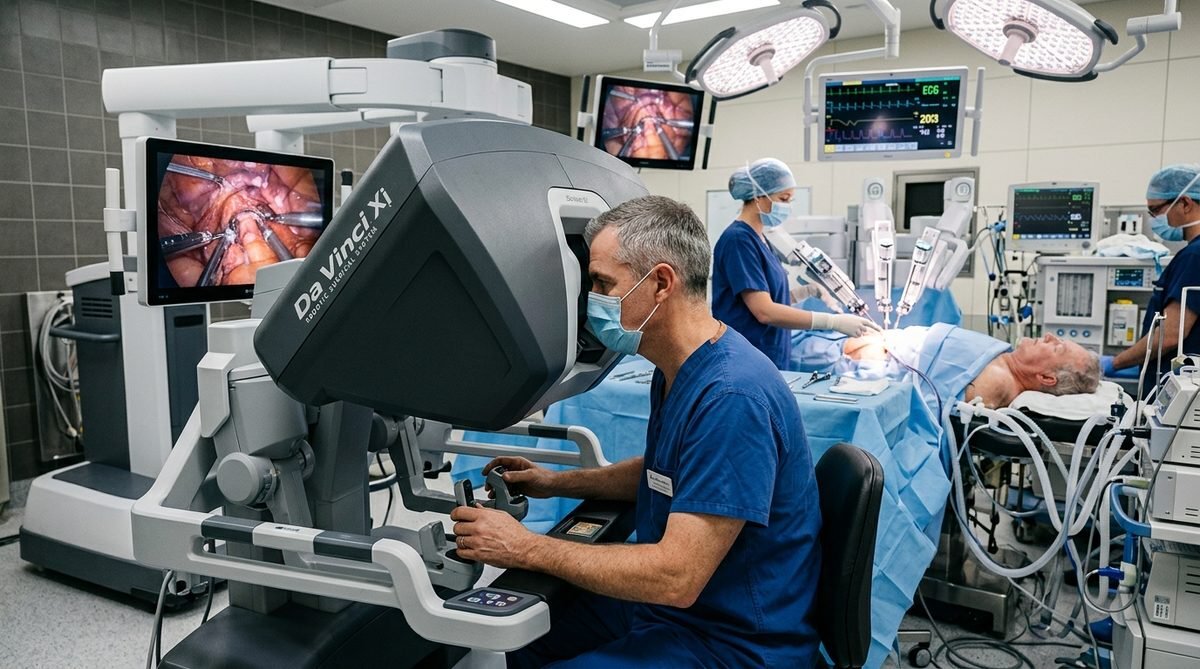
Yes. Radical prostatectomy, which removes the entire prostate gland, is a major operation whether done robotically or through open incision. It requires general anesthesia, usually takes two to four hours, and involves a hospital stay. Recovery typically runs four to six weeks before a man returns to normal activity.
The two most significant long-term side effects are urinary incontinence and erectile dysfunction. Incontinence after surgery often improves significantly over the first year, and the 2025 robotic series found comparable recovery rates across age groups at the 12 and 24-month marks. Erectile function recovery is more variable and depends heavily on whether the nerve-sparing technique could be used.
Mortality from the surgery itself is low but not zero. The large 35,968-patient review found a 30-day mortality rate of 0.1% in men under 60 and 0.3% in men aged 70 to 89. Serious complications including major bleeding, infection, and damage to surrounding structures occur in roughly 3 to 6% of cases depending on patient health and surgeon experience.
Hospital stay length is also affected by underlying health. A study of 236 prostatectomies found stays of 12 days on average in patients with comorbidities versus 9.7 days in those without, though mortality didn't differ between the under-70 and over-70 groups when patients were well selected.
Robotic surgery has meaningfully reduced blood loss and complication rates compared to open prostatectomy. A 1997 open-surgery study found major complications in 9.8% of cases overall, with health status rather than age driving that risk. Modern robotic series report figures well below that. The technology has improved the equation, but it hasn't eliminated the underlying biological risks of major pelvic surgery.
What Most Articles Get Wrong About Age and Prostate Surgery
The first mistake is treating age as a hard cutoff. There's no universal age at which surgery becomes forbidden. What exists is a combination of factors that, taken together, shift the risk-benefit calculation.
A 78-year-old marathon runner with aggressive cancer and a Charlson score of zero is a different patient than a 68-year-old with three chronic conditions and a slow-growing tumor. The numbers matter. But they have to be read together.
The second mistake is assuming that declining surgery means doing nothing. Active surveillance, radiation therapy, hormone therapy, and focal treatments like HIFU or cryotherapy all offer meaningful options for men who aren't surgical candidates. For many older men with low-to-intermediate risk cancer, active surveillance produces outcomes equivalent to immediate surgery, with none of the procedural risk. The decision to skip surgery isn't passive. It's often the most aggressive approach to protecting quality of life.
The third thing that gets missed is the role of patient selection in the data. When studies show that older men have similar outcomes to younger men after surgery, it's partly because the older men who made it into those studies were already the healthiest of their age group. The sickest patients were filtered out before surgery was ever offered. That selection effect is real and meaningful. It means the published complication rates for older surgical patients likely underestimate what would happen if age-based selection was removed entirely.
What the Decision Actually Looks Like in Practice
When a man in his late 60s or 70s sits down with a urologist after a prostate cancer diagnosis, the conversation usually covers three things: how aggressive is the cancer, how healthy is the patient, and how long is he likely to live.
A Gleason score of 6 in a 74-year-old with two chronic conditions will almost always lead toward active surveillance or radiation rather than surgery. A Gleason 8 or 9 in a 71-year-old with no comorbidities opens the surgical conversation seriously.
The cancer's aggressiveness raises the urgency. The patient's health sets the ceiling on what's safely achievable.
Life expectancy estimates are imperfect, but tools like Social Security actuarial tables, the Charlson comorbidity index, and validated life expectancy calculators give physicians a working framework. When that estimate falls below 10 years, most guidelines steer away from surgery for localized disease.
Beyond age 80, surgery for localized prostate cancer is rarely recommended in clinical practice. Comorbid disease has usually accumulated to the point where the operation carries more near-term danger than the cancer poses long-term. Exceptions exist for exceptionally healthy patients with very aggressive tumors, but they're rare enough that most guidelines treat 80 as a practical ceiling.
Frequently Asked Questions
Is there a specific age when prostate surgery is automatically ruled out?
No specific age automatically rules it out. Surgery is rarely recommended past 80 for localized cancer. The threshold is really about life expectancy and health rather than age in isolation.
Can a 75-year-old have prostate surgery?
Yes, if the cancer is aggressive, the patient is in good health, and life expectancy is reasonably estimated at 10 or more years. Complication risk is higher than at 65, but it's not prohibitive for a well-selected patient.
What happens if an older man chooses not to have surgery?
For low-to-intermediate risk prostate cancer, active surveillance or radiation often produces equivalent long-term outcomes to surgery. Many older men with slow-growing tumors will never experience symptoms from the cancer, regardless of treatment choice.
Does robotic surgery reduce risk for older men?
Robotic prostatectomy reduces blood loss and recovery time compared to open surgery, which benefits older patients. But the underlying biological risks related to anesthesia, cardiovascular stress, and comorbid disease aren't eliminated by the surgical approach.
What is the biggest risk factor for complications, age or health?
Health. Multiple studies identify comorbidity score, BMI, and cardiovascular status as stronger predictors of complications than age alone. Age matters because it correlates with accumulated health problems, not because the surgery inherently fails in older bodies.
What to Do Next
If you or someone close to you is weighing prostate surgery after 70, the most useful thing you can do is ask for a full comorbidity assessment before any surgical decision is made. Get a Charlson score. Get a realistic life expectancy estimate.
Ask specifically whether the cancer is aggressive enough to cause harm within your likely remaining years. Ask what the alternatives look like in your specific case.
Surgery is one option in a range of effective treatments. For many older men, it's the right one. For others, it carries more risk than the cancer ever would. The difference between those two men isn't their birthday. It's their body's overall capacity to handle a major operation and recover from it.
For specialist guidance tailored to your situation, the team at PTNA works with patients navigating exactly these decisions.Sources
Explore related health and wellbeing guides
This article is part of PTNA's consumer health and wellbeing library. Browse the Health & Wellbeing Resources hub to find related guides by topic, including Australian health cover, Medicare, prostate health, mental health, disability support and life insurance.
How Much Does It Cost to Have Your Prostate Removed Privately in Melbourne?
Read article →
Is It Worth Having Your Prostate Removed in Melbourne?
Read article →
Can You Get Anything Free if You Have Cancer in Melbourne?
Read article →
What Are the Negatives of Removing Your Prostate in Melbourne?
Read article →
Is Prostate Cancer Classed as a Disability in Melbourne?
Read article →